Better Higher Ed Data means Better Decisions
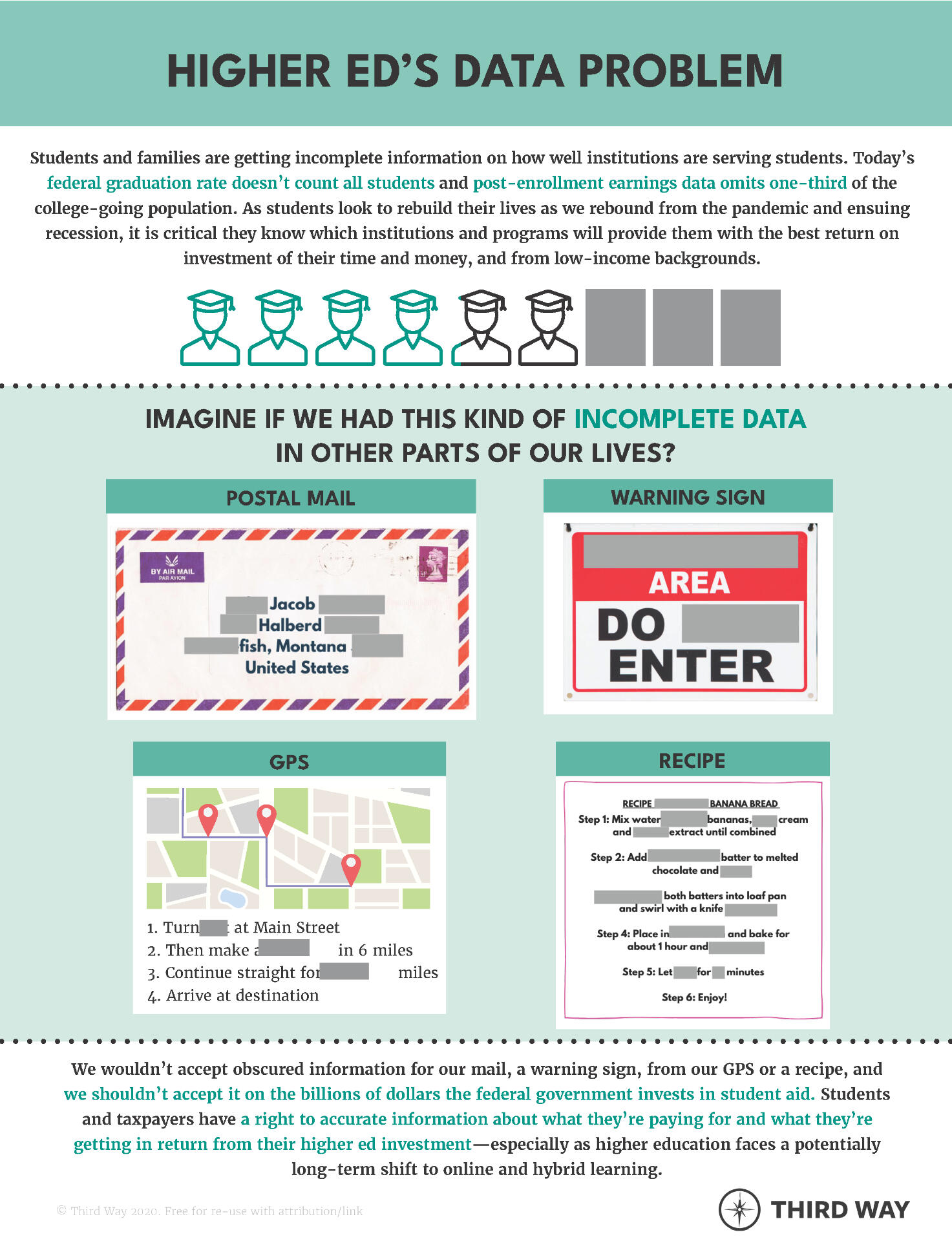
Investing in a college education pays off. Earning a bachelor’s, associate’s or postsecondary certificate increases job earnings and sets graduates on the path to lifelong economic security. But not all programs provide a meaningful return on investment for all students.Current federal law prohibits the collection and reporting of data on outcomes for all students at each college and university in the United States. This means students lack complete and useful information about outcomes at the colleges where they are considering investing their time and money.That needs to change.The College Transparency Act (CTA) is one solution with broad bipartisan support that will empower students and families to make better-informed choices about where to enroll. It will also give policymakers and institutions the data they need to make better-informed policy decisions that support student success.By creating a privacy-protected, student-level data network, CTA would give students and families the full picture on which institutions offer students the best return on their investment.
We’re celebrating the bipartisan reintroduction of the College Transparency Act. Check out the bill text here.
CTA in the News
Indy Star: Student debt shows need for 'transparency,' 'accountability' in cost of higher ed
Texas Tribune: Prove it: The value proposition of higher ED
Utah Policy: Keep Utah businesses competitive, pass higher ed reform
The Post and Courier: College isn’t worth much if you don’t graduate. Transparency Act would help.
NC PoliticalNews: Op-Ed: Higher ed reforms benefit our state’s economy
WBTW News: Local students welcome proposed bill to require more transparency from universities
The Columbus Dispatch: We can support Ohio’s veterans by reforming higher education
The Denver Gazette: Higher ed should serve those who served
Missouri Times Higher ed transparency is vital now more than ever
Greenville News How College Transparency Act would help families
The Salt Lake Tribune: Improved higher education equals more opportunity
Reveille: Students deserve transparency on enrollment, financial statistics from universities
Iowa OP-ED: Iowa's students deserve the College Transparency Act
The College Transparency Act is widely supported.
Over 180 organizations have signed onto the College Transparency Act and over 150 members of Congress have co-sponsored the bill in the House of Representatives.

Learn About CTA
The College Transparency Act would create a complete, secure, privacy-protected federal student-level data network that counts all students, empower students to choose the college and program that fits their educational and career goals, spur continuous improvement for colleges and universities to promote strong outcomes for all students, inform evidence-based policymaking at the state and federal levels, and illuminate equity gaps in college access, success, and post-college outcomes.
One-Pager: College Transparency Act
Letters of Support from Members
Letter of Support from Organizations
Blog Posts
U.S. Chamber of Commerce: Closing the Skills Gap Starts with College Cost and Value Transparency
New America: New Legislation Would Provide Students Key Information About College Outcomes
Reports
IHEP: Implementing a Federal Student-Level Data Network: Advice from Experts
Video
What People Are Saying About CTA
Deciding to invest time and resources in a college education is one of the most important decisions a student will make. To empower that decision-making, students need and deserve complete and useful information about how other students fare at the colleges and programs they are considering. The College Transparency Act reforms our existing data systems so students and families can access timely, high-quality, and user-friendly information. CTA will also empower policymakers with answers to key questions so they can craft evidence-based solution that promote better outcomes for all students, particularly students of color and students from low-income backgrounds. And by illuminating inequities facing students, CTA can support equity-minded, data-driven action among higher education institutions. We look forward to working with Congressional leaders to pass this critically important legislation.
Mamie Voight
President & CEO
Institute for Higher Education Policy (IHEP)
We thank the bipartisan sponsors in the House and Senate for their leadership working to bolster transparency of higher education outcomes. Where to attend college is a critically important decision for millions of students and families each year, and they should have robust data on labor market outcomes to inform their decision. The College Transparency Act would enable exactly this kind of transparency while also helping institutions and policymakers better understand how populations of students, such as student veterans, are succeeding to ensure the promise of higher education delivers.
Waded Cruzado
President
Association of Public and Land-grant Universities (APLU)
CTA serves the entire higher education community: it will provide students with better tools to weigh their college options, colleges and universities with insights to improve their student outcomes, and employers with a well-prepared workforce. Importantly, it achieves these aims while ensuring that student data are secure and privacy-protected, with robust data governance protocols to safeguard student information. CTA is a standout piece of legislation not only for its broad benefits, but also for its broad support across constituencies. It was the single most bipartisan bill by co-sponsor count in a prior Congress, and passed the House of Representatives on a bipartisan basis last year in an amendment to the America COMPETES Act of 2022. Beyond the Capitol, CTA has earned the public endorsement of over 160 diverse organizations, among them higher education institutions, civil rights groups, veterans’ organizations, student advocates, and the workforce and economic development community.
Lanae Erickson
Senior Vice President for Social Policy, Education & Politics
Third Way
For far too long, our understanding of postsecondary educational outcomes has been built on incomplete data that leaves out millions of students. The result has been policies that too often measure what is easiest to count instead of what matters most. The College Transparency Act will help change that by creating a secure, privacy-protected student-level data network that provides a more complete picture of who students are, where they enroll, how they progress, and what outcomes they achieve. Better information won’t solve every challenge facing higher education, but it is impossible to make sound policy—or for students to make informed decisions—without it.
Kevin Carey
Vice President, Education & Work
New America
The U.S. Chamber of Commerce (“Chamber”) strongly supports the College Transparency Act (CTA) and commends the bipartisan leadership of the Senate Committee on Health, Education, Labor, and Pensions (HELP) in advancing legislation to provide students and families with more complete information as they pursue postsecondary education. Historically, students have considered post-secondary education with the purpose of attaining a better job or more career opportunities. Yet, students and their families lack the robust data necessary to help them determine whether institutions of higher education truly deliver these outcomes, and whether the skills attained are aligned with employer needs. The CTA would change that. By providing accurate enrollment, completion, and postsecondary earnings by major, students would be able to find programs of study suited to their interests, while also meeting employer benchmarks. This would go a long way in addressing the work-readiness gap, in a market where high school graduates are viewed as less ready for work than previous generations.
Neil L. Bradley
Executive Vice President, Chief Policy Officer, and Head of Strategic Advocacy
U.S. Chamber of Commerce
Speak with experts working to make this happen:
Mamie Voight
Institute for Higher Education Policy
[email protected]Craig Lindwarm
Association of Public & Land-Grant Universities
[email protected]Wesley Whistle
New America
[email protected]Emmi Navarro
Third Way
[email protected]